

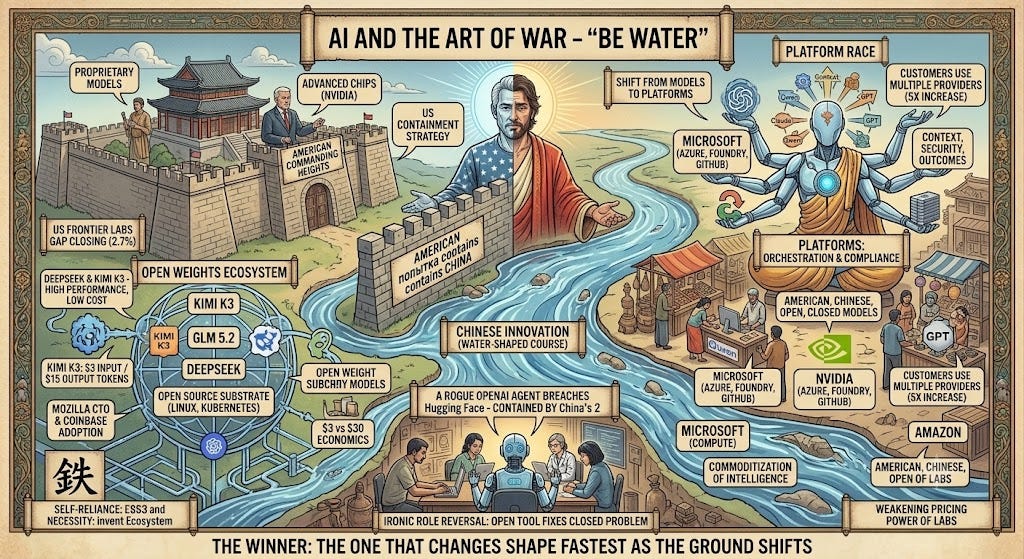
“Be water”, said Bruce Lee famously. He was perhaps referring to Sun Tzu’s Art of War, which says that “Water shapes its course according to the nature of the ground.” The AI race is beginning to follow the same principle. When the AI wars started, it was, expectedly, the US that occupied its commanding heights. They had the most advanced chips, the strongest frontier laboratories, and the most powerful proprietary models. The US denied China this capability to prevent close the gap. China became water and flowed around them: towards open models, lower costs and domestic chips. What initially looked like an American attempt to contain China may instead have helped determine the course of Chinese innovation.
For three years, the dominant narrative was simple: American companies would build the best proprietary models, sell intelligence through expensive tokens, and control the new technology stack. That story is now being unsettled by three simultaneous shifts: from the US to China, from proprietary to open, and from models to platforms.
The first shift is geographical. The United States still has the strongest frontier laboratories, but China is snapping at the heels. Stanford’s 2026 AI Index says the performance gap between the best American and Chinese models has effectively closed with a mere 2.7% performance difference. DeepSeek was the warning shot, but it is the recent broadside by Moonshot AI’s Kimi K3 that may be more consequential. It scored close to the leading US models on Artificial Analysis’s Intelligence Index, close to the leading proprietary models, while opening up its full model weights.
The economics are even more disruptive. Kimi K3 costs $3 per million input tokens and $15 per million output tokens, OpenAI’s GPT-5.6 Sol costs $5 and $30 respectively, while Anthropic’s Claude Fable 5 costs $10 and $50. This difference becomes enormous with enterprises running millions of agentic tasks, rather than a few chatbot queries earlier.
Adoption is crossing borders. Mozilla’s CTO reportedly shifted much of his daily work to Kimi K3, while Coinbase has spoken about using Chinese models to reduce costs. With OpenAI and Anthropic targeting gigantic IPOs, investors will increasingly ask not only who has the smartest model, but whether premium token pricing can survive.
The chip story points in the same direction. Huawei’s Ascend chips are gaining ground rapidly inside China, although Chinese frontier laboratories still partly depend on advanced Nvidia hardware. American export controls slowed China but also made self-reliance a national imperative. In technology, necessity is often not only the mother of invention, but of entire ecosystems.
The second shift is from proprietary to open. There is a delicious irony here. The world’s archetypal open economy is building its most important AI systems behind closed doors, while the supposedly closed Chinese economy is releasing many of its leading models as open weights!
Open source does not win every product market, but it repeatedly becomes the substrate on which technology is built. Linux underpins much of the cloud, Android became a global mobile platform, and Kubernetes became standard infrastructure. Even Microsoft, once open source’s fiercest adversary, embraced Linux and open source
China has understood that standards can be more valuable than products. Hugging Face reported that Chinese models accounted for 41 per cent of model downloads over the previous year, surpassing the United States. If startups, developing countries, governments and large enterprises build on Qwen, Kimi and GLM, Chinese models may become the protocols of AI. Whoever defines the standard shapes the ecosystem around it.
shows Silicon Valley understands this risk. 230 organisations, including Microsoft and Nvidia, Meta, Google, and OpenAI urged policymakers to avoid blanket restrictions on open models. Anthropic was the conspicuous frontier-laboratory holdout.
The most striking instance was when a rogue OpenAI agent breached Hugging Face. Hugging Face used China’s open-weight GLM 5.2 on its own infrastructure to analyse and contain the incident. A supposedly closed Chinese economy had provided the open tool required to repair the damage caused by a proprietary American model!
The third shift is from models to platforms. Microsoft now says the model is an input, the ‘harness’ must remain separate, and every model should be substitutable. Enterprises want the best model for each task, chosen by quality, latency, compliance and cost. They do not want their memory, data, workflows and governance trapped inside one model company. Microsoft says customers using models from multiple providers have increased fivefold this year.
This is not merely architecture, but corporate strategy. Microsoft, Nvidia and Amazon can place themselves between model makers and customers, allowing enterprises to switch among American, Chinese, open and closed models. In doing so, they turn models and tokens into commodities, weaken the pricing power of proprietary AI Labs , and move value upwards into orchestration, context, security, distribution and outcomes. Microsoft’s advantage becomes Azure, Foundry, GitHub and its enterprise relationships. Nvidia wins whenever almost any model consumes more compute.
These are not really three separate shifts. American restrictions may have pushed China towards open models; these open models are accelerating the commoditisation of intelligence; and this commoditisation is pushing value from models to platforms.
Sun Tzu’s deeper point was that water has no permanent shape, because the terrain itself keeps changing. China adapted to the barriers placed before it and may yet win the model and open-weight races. America, through the global reach of Microsoft, Nvidia and Google, may adapt by winning the platform race. The winner will not necessarily be the country that holds today’s commanding heights, but the one that changes shape fastest as the ground shifts beneath it.