

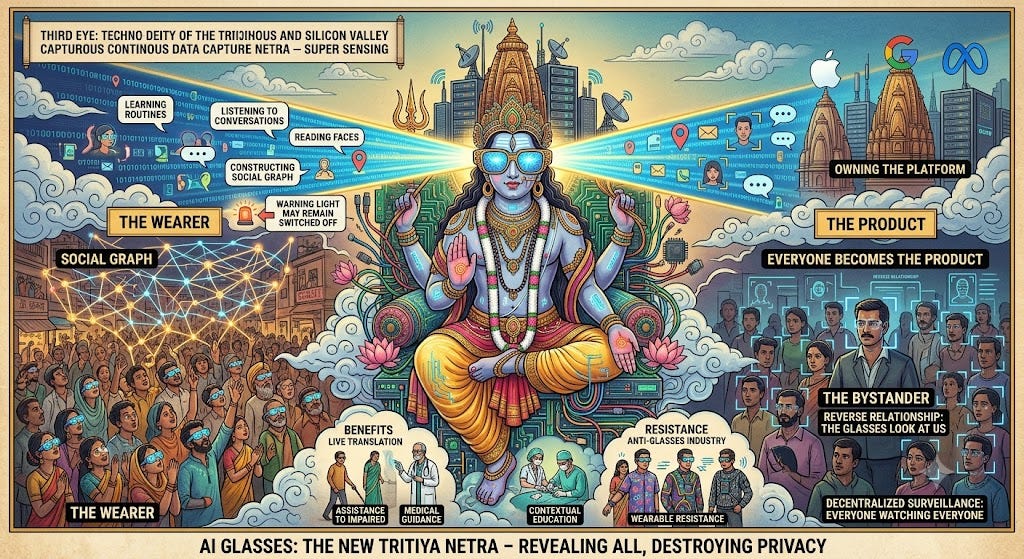
There is suddenly a frenzy around AI glasses. Ads for Meta’s Ray-Ban and Oakley glasses are all over in India. Snap has unveiled its new Specs. Apple has taken a more immersive route through the Vision Pro. Google, of course, tried this much earlier with Google Glass, whose wearers acquired the unflattering nickname “glassholes”, because other people could never be quite sure whether they were being watched or recorded.
People have been worried about their intrusive nature, but recent reports around Meta’s reported “super sensing” prototype makes the nature of the debate a little more sinister. They can continuously capture audio and take images every few seconds, creating an almost permanent record of what the wearer sees and hears. Even more troubling are the reports that whether the small warning light, which presently tells others that recording is taking place, might remain switched off during this always-on mode. Meta says the product is still being tested, but the direction is unmistakable. The glasses are no longer merely helping us see the world. They are beginning to see the world for Meta.
This raises the central question: who is looking at whom?
We think we are the subject, looking through the glasses at the world. But the relationship may be the reverse: the glasses are looking at us, learning our routines, listening to our conversations, reading the faces around us and constructing a continuous map of our social lives, the new ‘social graph’. The wearer may be the customer, but everyone within range becomes the product.
Meta has strategic reasons to build such a device. It has spent its life struggling inside app stores controlled by Apple and Google and the Glasses offer Meta the possibility of owning the next computing platform, rather than renting space on someone else’s. If the smartphone was Apple’s device, Zuckerberg sees ambient AI as Meta’s.
But this is also why the prospect is unsettling. Meta is not a company with a reassuring privacy record. Facebook’s history has involved repeated promises of control, confidentiality and responsible data use, followed by scandals involving profiling, political manipulation, behavioural targeting and the exploitation of attention. Its products have also faced serious criticism over their effect on children and teenagers. The documentary The Social Network eloquently captured something culturally true about the company’s origins: its instinct to convert social relationships, human curiosity and personal information into scale and power.
To trust Meta with AI glasses is therefore to trust a company built on observing behaviour with perhaps the most intrusive consumer device it has yet designed.
The problem becomes more acute in India. My own research on privacy in India suggests that we tend to be less privacy-sensitive than people in the West. Western privacy thinking is built strongly around the individual autonomy; what Warren and Brandeis famously called “the right to be left alone”. Indian attitudes are often more pragmatic and collective, routinely trading privacy for convenience, access, or economic benefit. We live in denser homes and public spaces, share devices, ask personal questions and have historically shown greater trust in institutions collecting our data.
That makes India an especially attractive market for AI glasses. Novelty, translation, navigation and status may matter more to many consumers than abstract questions about data capture. But lower concern does not make the intrusion less serious. It makes the population more vulnerable to it.
India is not just a low-privacy society, but also a low-consent society. We already take photographs at weddings, schools, offices and public events without asking. CCTV cameras proliferate without meaningful public debate. AI glasses could make this far worse because the camera would no longer be fixed to a wall. It would move through society on millions of faces.
This is the transition from centralised surveillance to decentralised surveillance.
CCTV largely meant that one central authority like a government or the police department watched many people. AI glasses could mean everyone watching everyone. Every commuter, tourist, or stranger could become a mobile surveillance node. Surveillance would no longer come only from above. It would diffuse horizontally, socially and invisibly.
There are, of course, real benefits. AI glasses could provide live translation, navigation, assistance to people with visual or hearing impairments, medical guidance and contextual education. A student could look at a machine, or a mathematical diagram and receive an explanation instantly. A doctor could access patient information without turning away from the operating table. A visually impaired person could receive a spoken description of the street ahead.
These benefits could pale in comparison with the dangers, and so we need strong safeguards. The recording light should be prominent and mandatory. Recording should require deliberate user action, not operate indefinitely in the background. Raw audio and video should not be retained automatically. Bystanders should have enforceable rights, not merely the hope that the wearer behaves well. This a vain hope given how mobile phone users play songs and Reels in public places, without any compunction.
We may even see the rise of an anti-glasses industry: clothing, patterns, lenses or electronic signals designed to confuse cameras and facial-recognition systems. Just as viruses produced antivirus software, wearable surveillance may produce wearable resistance.
Carissa Véliz has argued that privacy is power. Privacy is not merely the ability to hide embarrassing facts. It is the ability to retain agency when institutions know, predict and manipulate more about us than we know about them. AI glasses magnify that asymmetry because they do not simply collect what we type but accumulate everything we encounter.
In Indian mythology, Shiva’s third eye is not an ordinary eye. It is opened when the world must be transformed or destroyed. If used wrongly, AI glasses will become this ‘third eye’ – not only recognising and remembering everything but also destroying everything before them. In helping us see more, they will take away our last expectation of being left unseen.