

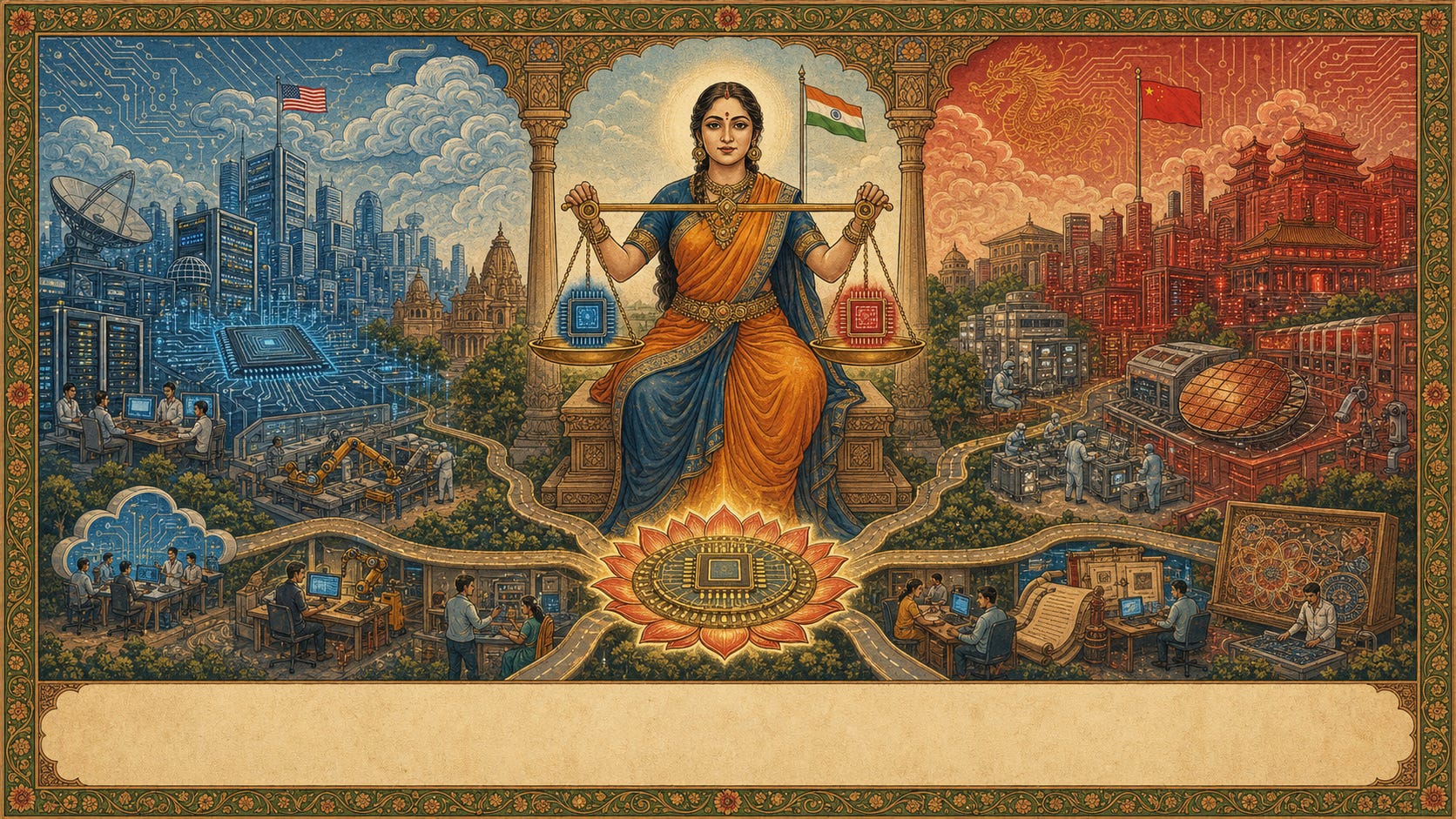
In 1961, when the world was divided into two great camps, India helped create a third way. The Non-Aligned Movement (NAM), shaped by Nehru along with leaders such as Tito, Nasser, Nkrumah and Sukarno, chose strategic autonomy over becoming a satellite of either the US or the USSR, the two superpowers of that era. Non-alignment was not about sitting on the fence, but the right of newly independent nations to make choices in their own interest. When the Soviet Union collapsed and the United States became the sole global hegemon, that logic, and the Movement, fizzled out after having served its purpose.
That past is coming back to haunt us, albeit in a different form. The new bipolarity is technological, and its most important battlefield is Artificial Intelligence. The United States is still one pole; China has replaced the Soviet Union as the other. Washington dominates frontier AI labs, advanced GPUs and cloud platforms, while China has built its own formidable ecosystem of models, chips, cloud infrastructure, devices and increasingly strong open-weight AI. The rivalry is becoming explicit, with Washington pushing partners to choose sides in emerging AI alliances while Beijing talks increasingly of digital sovereignty. Lost in the noise is the irony that an ‘open democracy’ is building closed proprietary models, and a ‘closed’ society is churning out the best ‘open’ AI models.
However, for India, this creates a familiar question: must we choose, and if so, who?
The fashionable answer is “sovereign AI”. India should have its own models, its own data and its own AI infrastructure. I support that ambition, but a mere sovereign model is not a sovereign AI stack. True full-stack sovereignty begins much lower down, with semiconductor design, fabrication and chipmaking equipment, then moves through compute, energy, data centres, cloud, data, foundation models, operating layers, applications and devices. If another country can switch off a critical layer, sovereignty is incomplete.
Full-stack sovereignty, therefore, is a seductive dream but, for most countries, a pipe dream. Only the US and China have anything close to the capital, industrial depth, research base, and geopolitical weight required to pursue it at scale. Even they have dependencies. For India, Europe, Japan, Brazil and most others, attempting to replicate every layer would consume extraordinary resources and still leave gaps.
The better idea is what I would call Non-Aligned Sovereignty, or NAS.
NAS is not technological isolation; it means preserving optionality. India should use the best Nvidia GPUs where indispensable, build indigenous compute and semiconductor capability where strategically important, use Indian models for Indian languages and public systems, deploy Chinese open-weight models where they offer cost and control advantages, and maintain multiple cloud and software options so that no single government or company can hold the country hostage.
Brazil has just offered an interesting glimpse of this approach. It announced a $444 million AI investment split across the two technological blocs. One project involves China’s Huawei and iFlytek, while another is expected to use Nvidia technology. Brazil is also working on RISC-V semiconductors, a national cloud and an algorithmic-transparency centre. Its objective is not anti-American or pro-Chinese, but to reduce dependence on any single provider or country.
India already understands this instinct outside technology. Our defence arsenal combines Russian, French, Israeli, American and indigenous systems. We can sit in the Quad with the US, Japan and Australia while remaining a member of BRICS. We can deepen strategic ties with Washington while maintaining relationships with Moscow and the Global South. Indian foreign policy increasingly calls this multi-alignment rather than non-alignment, but the principle is similar: autonomy comes from having choices.
AI should be no different.
This is urgent because AI dependence can become deeper than ordinary technology dependence. A country dependent on another nation for models is dependent on part of its intelligence layer. If it also depends on that nation for chips, cloud, operating systems and applications, it has effectively outsourced part of its economic and strategic nervous system. Export controls on advanced chips and restrictions around frontier AI access have already shown how quickly commercial technologies can become geopolitical weapons.
India is doing many of the right things. The IndiaAI Mission is expanding national compute, Indian companies like Sarvam are building foundation models, Bhashini is creating language infrastructure, semiconductor manufacturing is receiving serious policy attention, and enterprises are increasingly worried about vendor lock-in and data sovereignty. But the objective should not be an expensive imitation of the American or Chinese stack. It should be resilience through diversity.
The original NAM was born because India refused to exchange political independence for strategic dependence. AI presents a surprisingly similar choice. In the twentieth century, sovereignty meant not allowing another superpower to dictate our foreign policy. In the twenty-first, it may mean not allowing another country, or corporation, to control the chips we compute on, the models we think through and the platforms our economy runs on.
India does not need full-stack sovereignty to be sovereign. It needs enough control over critical layers, and enough alternatives everywhere else, to retain the freedom to choose.
That is the new non-alignment. From NAM to NAS.