

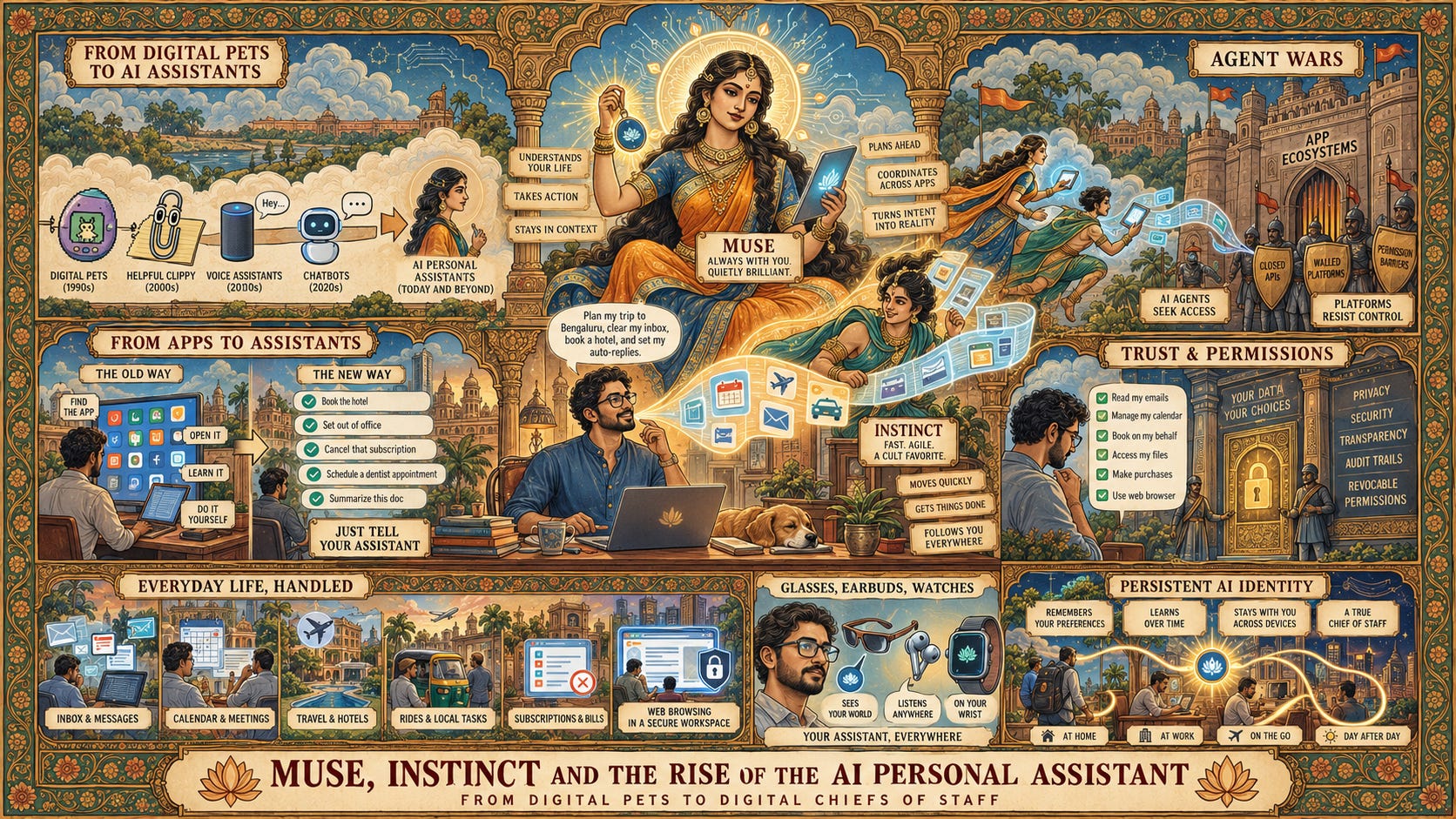
Thirty years ago, children walked around feeding a tiny digital creature called a Tamagotchi. It beeped when it was hungry, sulked when ignored and demanded that humans organise their lives around it. At Meta Connect this week, Mark Zuckerberg unveiled something that looks uncannily similar: Muse Charm, a palm-sized, keychain-like home for Meta’s new personal AI agent. It is the first real ‘hardware for AI’ people have been talking of. But there is a more important story behind the gadget. After years of chatbots, copilots and voice assistants, AI may finally be approaching one of computing’s oldest holy grails: the true personal assistant.
Not an app that answers questions, or a Siri that sets an alarm, or even a ChatGPT that polishes out an email. This is a real AI PA would be closer to a chief of staff or alter ego: persistent, personalised, aware of your past and priorities, able to act across your work and life, and increasingly capable of anticipating what needs doing even before you ask.
This shift was visible even before Muse. Instinct, an invite-only assistant founded by 23-year-old Noah Shinn, became something of a cult product among early adopters this summer. It connects to email, messaging, calendar and other personal systems, and can be reached by text, WhatsApp or phone. Users ask it to book hotels, organise inboxes, arrange rides, cancel subscriptions or simply follow up on the loose ends of life. The startup raised $250 million at a $2.5 billion valuation in August, and is said to be at $10bn just a month after!
I have been experimenting with Instinct myself. I connected it to my email and recently asked it to set up my out-of-office message. I did not open Outlook, search through settings or configure anything. I simply asked my assistant, and it did that. That tiny example hints at a much larger change: computing moves from “find the right app and operate it” to “tell someone what you want done.”
Meta’s Muse pushes this idea into the mainstream. Muse can connect to email, calendars and other services, browse the web through its own secure virtual machine, book appointments, fill forms, shop, track long-term goals and continue working after you close the app. Meta says it asks for approval before sensitive actions such as purchases or sending messages. Within weeks of launch, Muse reached the top of US app charts; Meta is now putting it into its glasses and, through Muse Charm, giving it a little body of its own. It will soon be available globally, including in India.
The genealogy is amusing. Microsoft’s much-mocked Clippy was an early ancestor, forever popping up to ask whether we were writing a letter. Then came Siri, Google Assistant and Alexa: useful for timers, weather and music, but rarely something one would call a chief of staff. Generative AI gave assistants language and reasoning; agents are now giving them hands.
And suddenly everybody wants one. Apple’s new Siri AI can draw on messages, emails, photos and on-screen context, and act across apps. Google’s Gemini Spark works in the background across Gmail and Workspace. Amazon’s Rufus, now Alexa for Shopping, already searches, compares, tracks prices and can auto-buy under certain conditions. The next platform war may therefore not be over the best chatbot. It may be over who becomes the trusted intelligence sitting between you and the rest of the digital world.
That word “trusted” is key here. A genuinely useful personal assistant must know almost everything you normally protect - email, calendar, contacts, location, preferences, purchases, perhaps bank details, health information and intimate conversations. It becomes useful precisely because it becomes intrusive. The better it knows you, the better it can serve you.
Instinct has already faced criticism over the breadth of permissions and data rights in its terms. Meta says Muse uses secure credential storage, virtual machines and permission controls, and that Muse conversations are not shared with its advertising systems. Yet Meta’s long history of privacy controversies means many users will understandably demand more than assurances before handing it the keys to their lives.
Then, there is also a new kind of platform conflict. Amazon has already blocked Muse from shopping on Amazon, arguing that Meta’s agent was accessing its systems without authorisation and raising privacy and security concerns. That is a glimpse of a coming agent war: my assistant may want to act for me, while your platform may refuse to let it in. The internet built for humans browsing websites may have to decide whether their autonomous digital alter egos have right of way.
The hardware will follow the assistant. Today it is a phone, Rabbit or Charm; tomorrow it may live in glasses, earbuds, watches or whatever replaces the smartphone. The important continuity will not be the device. It will be the persistent AI identity that follows us everywhere.
That may ultimately be what personal computing was always trying to become - not a computer that belongs to you, but a computer that knows you. The relationship, however, has flipped. The old Tamagotchi needed us to look after it, while this one wants to look after us. The first Tamagotchi needed us to remember its life and looked after us; the new one may remember ours and looks after us. The child has become the parent.