

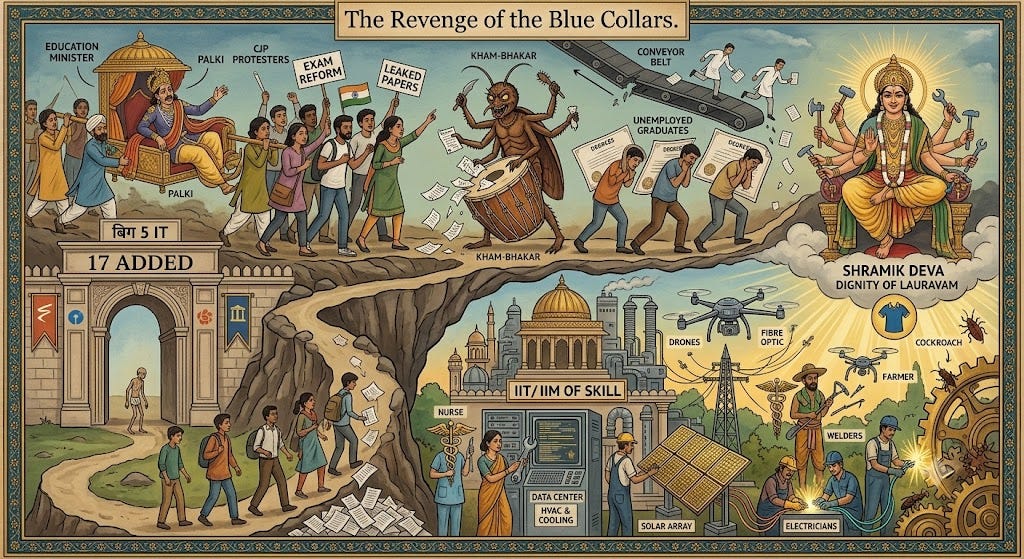
17.
That is the net number of employees added by India’s five largest IT services companies, TCS, Infosys, Wipro, HCLTech and Tech Mahindra, during the first nine months of the 2025–26 financial year. Not 17,000. Just 17.
During the corresponding period a year earlier, these companies had added 17,764 employees. For several decades, they were among India’s most dependable employment machines, absorbing hundreds of thousands of young engineers from colleges across the country. Now, that machine seems to be sputtering
This number may explain the Cockroach Janta Party protests better than much of the commentary around them.
At the surface, the protests were about leaked examination papers, a broken testing system and the resignation of the education minister. Those were real and legitimate demands, and the movement succeeded in securing the minister’s resignation and promises of examination reform. But peel away a few layers and the anxiety appears much larger. Young Indians are beginning to ask whether the bargain offered to them by the education system still holds: study hard, clear increasingly competitive examinations, obtain a respectable degree and a respectable job will follow.
What happens when the examination is compromised, the degree devalued. and that kind of job is no longer exists?
India’s youth are already in a difficult place. More than four out of every five unemployed Indians are below 30, while unemployment among graduates is many times higher than among people who cannot read or write. Real wages have remained largely stagnant, and many government skilling programmes have produced certificates without producing employment.
Graduates consequently find themselves working in jobs for which they are grossly overqualified. Engineers become construction supervisors, postgraduates take up data-entry assignments, and graduates enter poorly paid gig work without security or a clear career ladder. The anger over examinations is therefore also anger over what lies at the end of them.
AI is intensifying this apprehension.
The first tasks being automated are often those traditionally given to young entrants: preparing presentations, summarising documents, writing basic code, conducting basic research, checking contracts and creating routine reports. These were not merely low-value tasks. They were how young people learnt to work. They watched seniors, made mistakes, understood organisations and gradually developed judgment.
The bottom rung of the white-collar ladder is not simply becoming harder to reach. In some professions, it is being removed.
This strikes directly at the 21-year-old engineer or 23-year-old MBA who followed India’s traditional career conveyor belt: school, engineering college, perhaps an MBA, campus placement, management trainee programme and then the long corporate climb. Or engineering followed by a mass-recruitment offer from the aforesaid IT services company, several certifications and a lifetime orbit around software.
That conveyor belt is breaking.
Young people will certainly need AI literacy. They must learn to work with these systems, question their output, understand their limitations and use them to become more capable in their chosen fields. Humanities, judgment, context and domain knowledge will also become more valuable as routine answers become easier to produce. Entrepreneurship will become more practical because one or two people equipped with AI can now build, market and operate businesses that once required much larger teams.
But the most important response may be the simplest: do what you were trained for.
For decades, India took mechanical, civil and electrical engineers and converted them into software engineers. A mechanical engineer maintaining machines was considered less successful than one writing code for an IT services company. An electrical engineer working on power systems received less prestige than someone preparing PowerPoint presentations in a consulting firm.
AI may reverse that hierarchy.
The AI economy is not made only of models and software. It needs concrete data centres, copper cables, steel, transformers, cooling systems, renewable-energy installations and fibre networks. These, in turn, need electricians, HVAC technicians, welders, construction workers, maintenance engineers, solar technicians, equipment operators and people who can build and repair things in the physical world.
This may be AI’s most unexpected employment effect. A technology associated with replacing labour could help produce a renaissance of skilled blue-collar and grey-collar work.
India should seize that opportunity. Instead of continuing to open more engineering colleges whose graduates chase a shrinking number of generic office jobs, we need the IIT/IIM like institutes for data centre electricians, robotic machinists, healthcare technicians, solar installers, and drone operators. Importantly, these should not be treated as remedial institutions for those who supposedly failed academically. They must become aspirational institutions with modern equipment, strong industry partnerships, serious apprenticeships and credible employment pathways.
Wages matter, but dignity matters just as much. India has long treated white-collar work as intellectually and socially superior to work performed with tools, machines, bodies or hands. Some of this prejudice comes from caste and feudal attitudes towards manual labour. Some comes from the post-liberalisation worship of engineering degrees, MBAs and “techie” office jobs.
A young person earning five lakh rupees in an IT company is frequently regarded as more successful than a shopkeeper, physiotherapist, or pet-care professional earning twice as much. We judge the colour of the collar rather than the competence, usefulness or income.
The CJP protests contained the possibility of a different social imagination. The protesters were not separated by corporate designation, college pedigree, caste hierarchy or the colour of their collars. They appeared simply as young Indians confronting a system that they believed had failed them. There was something almost classless about the movement, a rough equality born from a shared fear about the future.
That equality must now extend to work. The electrician servicing an AI data centre is as much a technology worker as the programmer training the model. The technician, nurse, farmer, physiotherapist and welder are no less essential than the consultant, coder or manager.
India’s employment future may depend upon finally accepting what its young protesters briefly demonstrated on the streets: blue-collar and white-collar work are different, but neither is inferior to the other.
The so called NEET students protest had nothing to do with either NEET nor Students, except an attempt by the Anti Social and Anti national elements coming together to carry on a trial run of the devious Regime Change exercise which was carried our successfully in Bangladesh earlier, of course with the direct support & involvement of the Deep State & other notorious international Funding Agencies pumping money and resources in their attemit to instigate and monitorily motivate these universal pests, aptly named Cockroaches, to create total anarchy , complete chaos and lawlessness, across the country and thereby bring the nation and its progress to a grinding halt!
And your effort here attempting to justify & give some sense of credibility and reasoning for the engineered & fraud protests by a group with no real students or Gen Z involvement & participation is but a rediculos, kite flying exercise born out of a figment of imagination deep rooted in malice and hatred for India, the fastest growing economy in the world, as of now!