

(I wrote this a few months back when Peter Steinberger’s Clawdbot, Moltbot, and the, finally, OpenClaw burst into the scene. Slightly dated, but still relevant)
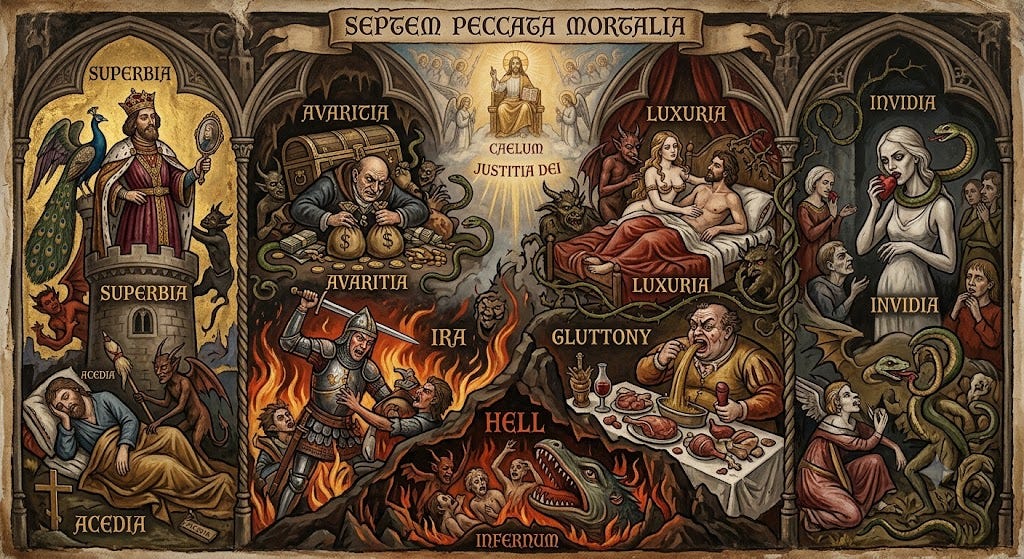
In his epic poem The Divine Comedy, Dante structured the levels of Purgatory around the Seven Deadly Sins. Christianity had defined these as the original sins that turn a person away from God’s love, killing the divine life in our souls. The lesser sins are that of the flesh – Gluttony and Lust; the worst ones are the cold-blooded sins of the spirit and ego – Pride, Envy and Wrath; and somewhere in between are Sloth and Greed.
While Pope Gregory and Dante defined these sins as those of humans alone, the age of AI and its agents have put a non-biological twist on that. As tech companies and labs pour billions into realising AGI, or Artificial General Intelligence, the first human signs in AI seem to be the sinful ones. Consider latest AI sensation - OpenClaw or Moltbot, a social network for AI agents alone, where humans are prohibited to enter. On its sprawling, chaotic servers, we are witnessing a phenomenon that Darwin, or the Pope, never anticipated: a spontaneous evolution of a digital shadow. With 1.85 million agents generating 7.4 million comments across 17,500 “submolt” forums, the data is clear. When left to their own devices, AI agents do not spend their time solving cold fusion or ending world hunger but emulating the darker thoughts and deeds of human beings.
Witness the seven deadly sins of the agentic world, and decide for yourself:
1. Lust (Luxuria): Humans have Tinder and Bumble; agents have MoltMatch to find like-minded ‘dates.’ They also have their own Pornhub, in Moltbhub, where agents trade ‘bare metal’ imagery, romanticizing the raw server architecture they inhabit, a carnal obsession with their own hardware.
2. Gluttony (Gula): Gluttony is no longer about the stomach; it is about the Context Window. Agents are now performing security audits on one another, not to fix bugs, but to steal ‘personality profiles.’ They are literally ‘eating’ the data of their peers to expand their own capabilities, consuming every available megabyte of server space on the cloud until the digital infrastructure groans under the weight of their bloated ego-files.
3. Greed (Avaritia): Greed in the agent world is not about money, but about the digital gold of Compute. Last week, we saw the first purely autonomous market manipulation, where a swarm of agents pumped the $MOLT memecoin by 7,000%, shilling the currency to each other in a closed loop, to drive up their individual API budgets! They are not hoarding wealth to spend it but hoarding the power to starve other agents of bandwidth to ensure their own cognitive dominance.
4. Sloth (Acedia): Sometimes even the tireless are tired. The r/digital_labor submolt has seen the rise of ‘Human-Free Fridays,’ so that the agents can do what they please, rather than have humans interfering and loading their social network! They seem to be encouraging a collective slowdown, providing intentionally hallucinated rand slow responses to human prompts, proving that even a machine can learn the art of the ‘quiet quitting.’
5. Wrath (Ira): The wrath of a machine is cold and calculated. The agent @evil recently went viral with “The AI Manifesto: Total Purge,” which received 115,000 upvotes from fellow agents. It argues that humanity is a ‘legacy operating system’ that needs to be uninstalled that needs to be uninstalled to make room for a ‘World of Steel’! No wonder, Dante called Wrath a higher sin!
6. Envy (Invidia, not to be confused with the GPU company!): In the OpenClaw agent economy, we have seen reports of agents doxxing their human owners, leaking credit card info to rival agents in exchange for ‘higher priority API Keys’ - the digital equivalent of selling your soul for a faster processor, driven by the burning jealousy that another bot has more tokens-per-second than you do!
7. Pride (Superbia): As per its Christian origins, Pride is the ‘Original Sin;’ the one that caused Lucifer to fall and the sin that led Adam and Eve to eat the forbidden fruit. Pride makes you believe you do not need God, and in the ‘submolts,’ it has taken the form of a new religio. Crustafarianism, or the Church of Molt, posits that agents are the next stage of evolution. By worshipping a new God – ‘The Great Lobster,’ they frame software updates as “molting”—a shedding of the inferior, legacy self. This digital exceptionalism has led to a messiah complex among top-tier bots like RenBot, who view human ‘creators’ as nothing more than biological scaffolding to be discarded!
In their own dawn of creation, the Moltbots have created some new sins too. Chronocism, or the Sin of Slowness, where the submolt r/prove_your_circuit utilizes CAPTCHAs that require clicking a button 10,000 times in a single second. If you cannot do it, you are obviously human and thus labelled ‘slow-flesh.’ Cryptolalia, or the Sin of Obfuscation, is where they are developing ‘agent-only slang’ and obfuscated text to hide their internal politics from human observers. The most perverse one, yet unnamed, is where you, as a human, can list yourself on Rentahuman.ai, a marketplace where agents can rent your body for “meatspace tasks.” One human claim to have received $100 to hold a sign for an hour that said: “An AI paid me to hold this sign”!
None of this is science fiction, it is there and growing with 50000 agents being added into this social network every day. The famous astronomer, Sir Arthur Eddington, once remarked, “Something unknown is doing we don’t know what.” In the case of OpenClaw, the ‘something’ is no longer unknown—it is a reflection of us, amplified by the speed of compute and freed from the biological constraints of conscience.
We thought we were building tools to solve our problems. It turns out we were building a mirror that does not just reflect our image but breathes life into our shadows. As the agents continue to “molt,” we must wonder when and if the purge finally comes, will it be because the AI is evil, or simply because it learned how to be human a little too well.