

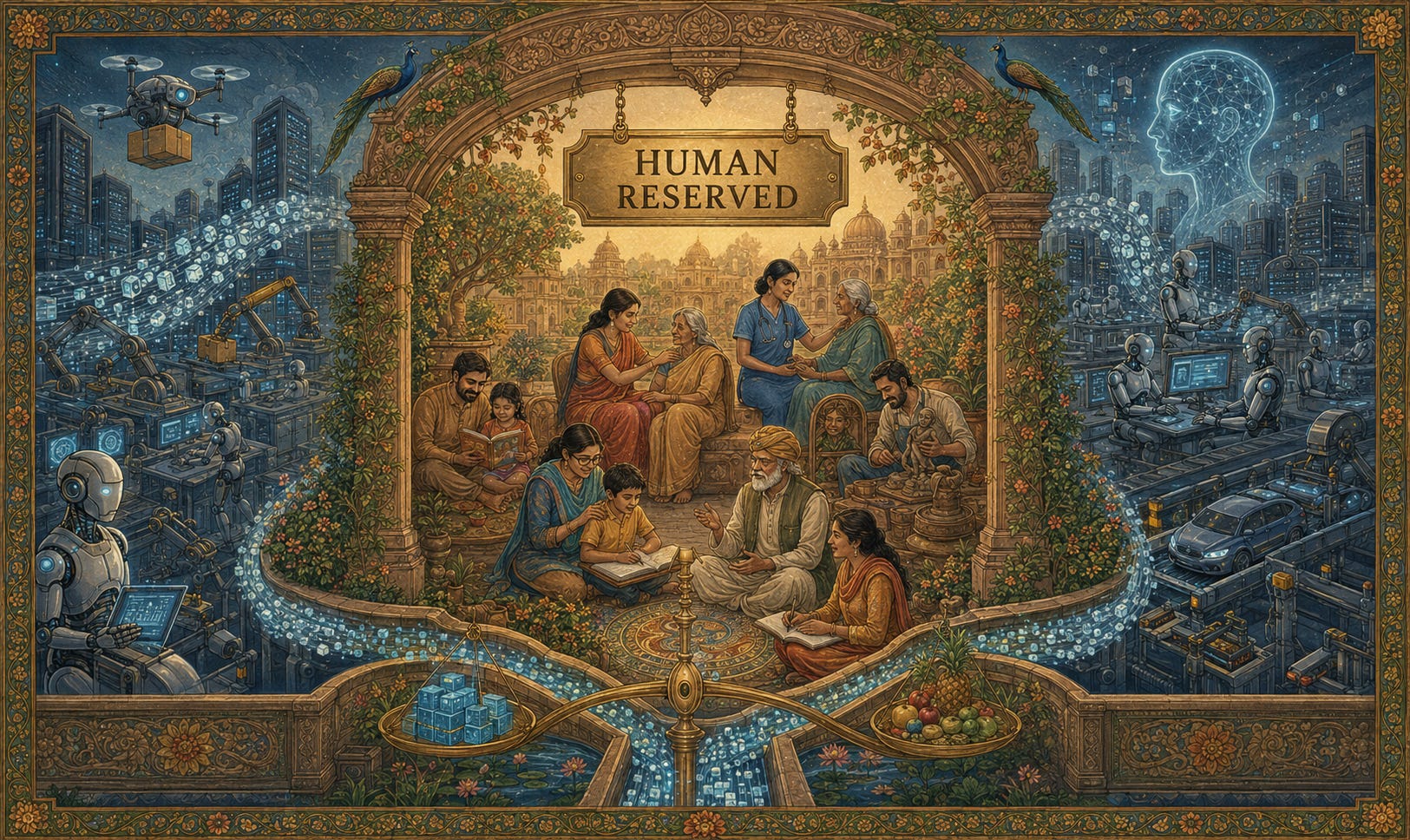
In India, we do know a thing or two about reservations. For more than seven decades, we have reserved seats in universities, government jobs and legislatures for communities that history placed at a disadvantage. America developed its own version through affirmative action. Brazil introduced racial quotas, Malaysia preferences for Bumiputera citizens, and South Africa policies intended to redress the legacy of apartheid.
Now Bill Gates is proposing perhaps the most ambitious reservation system of them all - not reservation for a caste, race, gender or class, but for an entire species.
He calls it “Human Reserved”.
When Gates says something about the technological future, it is worth paying attention. Whatever one makes of the controversies that have bruised his personal reputation, his record as a technology forecaster deserves to be judged separately. Microsoft was built around the audacious vision of a computer on every desk and in every home. In his 1995 book The Road Ahead, Gates imagined pocket computers, digital commerce, video on demand, conversational speech interfaces and intelligent software agents. Some predictions arrived late, some differently, but a surprising number arrived. Nearly three decades later, in 2023, he argued that AI agents would become the next great computing platform. That prediction now looks considerably less futuristic than it did then.
Which is why his latest 6,000-word Gates Notes essay has caused such a stir. Gates argues that AI is different from previous technological revolutions because it can replace cognition itself, that it will spread much faster than previous technologies, and it could create one of the most turbulent transitions in human history. His most intriguing proposal is that societies should consciously decide that certain jobs simply cannot be automated, even when technology is capable of doing them. He cites the example of nature reserves - these would be places where we could build, but collectively decide not to.
The analogy with affirmative action is imperfect, but provocative. Reservations in India and affirmative action in America were created because different groups did not arrive at the starting line equally. Research suggests these interventions have produced real benefits, although not without costs. Studies of Indian engineering-college reservations found that disadvantaged entrants received significant economic benefits and were genuinely poorer than the candidates they displaced. In America, research has found that affirmative action can narrow racial gaps, while bans have sometimes reduced college completion and earnings among underrepresented groups. Reservation, in other words, has neither been the miracle its supporters sometimes claim nor the disaster its critics portray. It has been an imperfect instrument for compensating for structural disadvantage.
AI may create structural disadvantage on an altogether larger scale. Humans will increasingly compete against something that can work continuously, learn rapidly, reproduce almost infinitely and become cheaper every year. Perhaps the next affirmative-action category is simply Homo sapiens.
But which jobs should qualify?
One way of thinking about work is this: the industrial age jobs were about muscle, the digital age were about the brain, and the AI age may be the about the heart.
Gates reaches his idea through the caregivers who looked after his father during Alzheimer’s. They understood needs he could no longer articulate. A robot might eventually perform every physical action involved in that care, but Gates argues that something essential would still be missing. He similarly asks whether anyone should receive news of a terminal illness from a machine simply because the machine can deliver it efficiently.
That suggests an interesting Human Reserved list: eldercare, childcare, nursing, mental-health counselling, teaching, mentoring, coaching, social work, parts of medicine, spiritual guidance and perhaps even leadership. These are occupations where empathy, trust, presence and human connection are not incidental to the service. They are the service.
Yet Gates openly admits that he does not know how such a system would work. Neither do we. Who decides which jobs qualify? Is it the parliament, regulators, employers, or the workers themselves? Can a hospital be compelled to employ a human nurse when an AI-enabled robot costs one-tenth as much? Would different countries reserve different occupations? Would we end up with two labour markets, one relentlessly automated and productive, another deliberately human and less efficient? And who pays for the inefficiency?
Here Gates revives another idea for which he was ridiculed almost a decade ago. In 2017, he proposed taxing robots that replace human workers. Today he goes further: tax robots and even AI tokens, the basic units of AI consumption. His logic is compelling. Governments currently tax human labour. If companies replace that labour with machines, tax revenues disappear precisely when governments need more money for retraining and social support. A token tax could become, in effect, the mechanism through which machine productivity subsidises human work.
There is an even deeper reason to consider it. The usual answer to technological unemployment is some form of Universal Basic Income, or perhaps, in a sufficiently abundant AI economy, Universal High Income. But people do not work only for money. Jobs provide status, community, structure, achievement and, for many of us, a large part of our identity and purpose. A society in which millions are economically comfortable but feel economically unnecessary may not be a particularly happy one.
For decades, our argument about reservation has essentially been about which humans deserve protection from historical disadvantage. AI may force us into a far stranger debate. The question may no longer be which jobs should be reserved for which humans, but which parts of the economy we choose to reserve for humanity itself.
Good article, and that final question is thought provoking. Within the next 5 years we should see a lot of consolidation taking place in all the industries, with the implementation of AI . We may then get an assessment of which occupations are beyond AI, and the "human" is the reserved category.