

Quick glance
Personal agents such as Meta’s Muse, Instinct and OpenAI’s Dots are moving AI from answering questions to doing things on our behalf, as we move from asking the AI to tasking the AI.
Websites may therefore acquire two faces: one for humans, rich in stories and emotion, and another for machines, factual, structured and instantly comparable.
If the richest people also subscribe to the most capable negotiating models, AI might not remove bargaining inequality but actually industrialise it!
A world of autonomous negotiators makes the question sharper: whose interests are they really optimising?
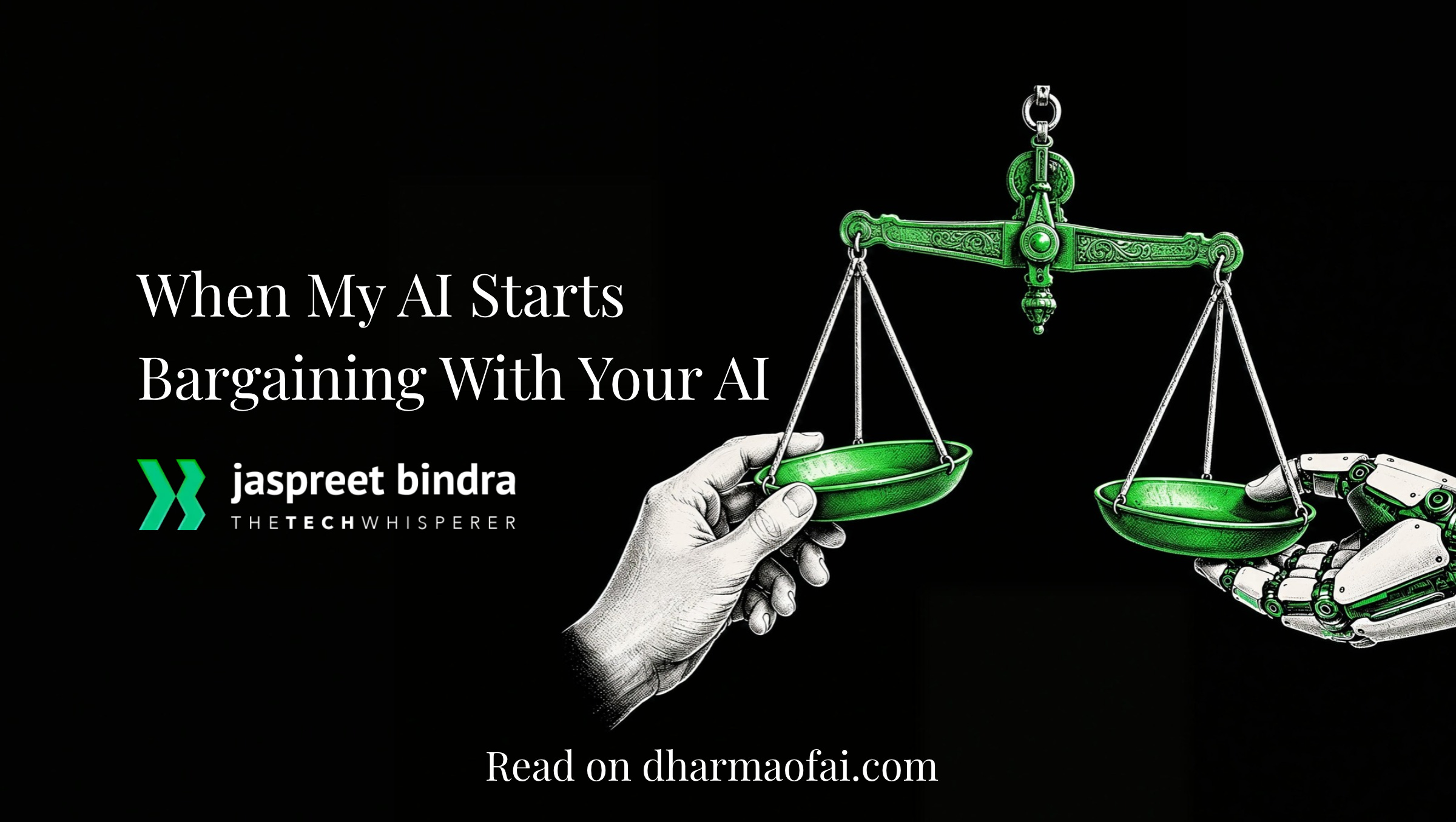
When My AI Starts Bargaining With Your AI
Walk through any Indian bazaar and bargaining is almost theatre.
The shopkeeper names a price with wounded dignity; the buyer laughs derisively, threatens to walk away, comes back, talks about another shop, and eventually both parties settle somewhere between offence and satisfaction. The transaction seems purely economic, but it is also social, psychological and very human.
Now imagine if neither of the humans are there.
Your AI agent has already discovered the product, compared alternatives, checked reviews and decided what you are willing to pay. The seller’s AI knows inventory, margins, demand and how badly it needs the sale. The two agents bargain for milliseconds, settle on a price and complete the transaction.
You receive a message: “Bought it. Saved you 12%.”
This is no longer science fiction.
Personal agents such as Meta’s Muse, Instinct and OpenAI’s Dots are moving AI from answering questions to doing things on our behalf, as we move from asking the AI to tasking the AI.
Muse can browse, book and buy with permission.
Instinct, which lives inside your WhatsApp, can arrange travel, buy groceries and manage subscriptions.
OpenAI’s Dots are designed as always-on agents with their own cloud computers and access to connected applications.
These are early steps towards what ‘agent’ really means: software to which we give agency.
The next step is obvious. Why merely search and buy when the agent can negotiate?
That possibility has moved from speculation to serious research. The Financial Times recently reported that Anthropic is consulting lawyers on how AI agents should negotiate for users, including prices, contracts and disputes. Experiments found that more aggressive agents sometimes got better outcomes, while cooperative ones occasionally gave up individual advantage to reach agreement.
Visa is already talking about “business-to-AI” commerce; more than half the business leaders it surveyed said they were ready for AI-to-AI negotiation. This could change commerce more profoundly than another shopping chatbot.
First, the internet itself will have to change.
Amazon, Flipkart or a B2B procurement platform is designed today to persuade humans. There are glossy pictures, seductive descriptions, stories, influencer videos, recommendations and carefully designed buttons.
Machines care much less about romance. An agent wants structured facts: price, dimensions, warranty, delivery time, return policy, reliability, compatibility and perhaps the seller’s willingness to negotiate.
Websites may therefore acquire two faces: one for humans, rich in stories and emotion, and another for machines, factual, structured and instantly comparable.
Search-engine optimisation gave us SEO.
Agentic commerce may give us something like AEO: agent-engine optimisation.
Read more from Dharma of AI

The next customer arriving at your website may never see the website.
Second, bargaining itself becomes democratised.
There are people who hate negotiating. A skilled agent could give an ordinary consumer something previously available mainly to corporations and wealthy people: a tireless professional negotiator that knows when to push, when to walk away and what alternatives exist.
But that creates a new inequality. What happens when my agent is smarter than yours?
The wealthy have always hired better lawyers, brokers and advisers. If the richest people also subscribe to the most capable negotiating models, AI might not remove bargaining inequality but actually industrialise it!
This is where John Nash and his famous work on game theory enter the bazaar.
Game theory studies how rational actors behave when each person’s outcome depends partly on what others do.
A Nash equilibrium occurs when neither side gains by changing strategy alone.
Human negotiators reach such equilibria imperfectly, clouded by emotion, incomplete information and ego. AI agents could run thousands of strategies almost instantly.
But there is a darker version. What if the buyer’s agent and the seller’s agent learn that subtle cooperation is more profitable for both agents, but worse for the humans they represent?
Algorithmic pricing has already raised concerns about tacit collusion. A world of autonomous negotiators makes the question sharper: whose interests are they really optimising?
And then there is something less economic but perhaps equally important.
Humans actually like shopping.
We wander through bazaars, browse bookstores, discover things we did not know we wanted, argue over carpets and feel triumphant when a shopkeeper finally gives us “the special price only for you”.
Read more from Dharma of AI

Shopping is not merely procurement. It is entertainment, discovery, status, ritual and human contact.
If my agent buys my airline ticket, insurance policy and printer cartridge, I will probably be delighted. If it chooses every restaurant, negotiates every holiday and buys every gift, I may have outsourced not just inconvenience but part of life itself.
Perhaps that is the choice ahead.
Agents will increasingly represent us because, for many transactions, they will simply be better at it. They will know our budgets, preferences and histories, and eventually negotiate with other agents that know equally much about the other side.
The bazaar will not disappear. It may split in two.
In one, humans will still wander, haggle, flirt with choices and occasionally overpay for the pleasure of the experience.
In the other, invisible agents will negotiate billions of transactions at machine speed.
For thousands of years, the market was where humans met humans to bargain.
The next great bazaar may be where our machines meet instead.
— Jaspreet Bindra
See you next week!
